International shipping has become an essential part of modern commerce and everyday life. Businesses rely on global logistics to deliver products to customers worldwide, while individuals frequently send important documents, gifts, and personal belongings across borders. Regardless of what you’re shipping, knowing where your package is at every stage of its journey provides peace of mind and helps you plan accordingly. This is where DHL Tracking plays a vital role. Instead of wondering whether your shipment has left the warehouse, cleared customs, or reached its destination, you can monitor its progress in real time. Accurate tracking not only improves transparency but also reduces uncertainty, making international shipping more reliable for both businesses and individuals.
Whether you’re managing multiple business shipments or waiting for a personal package, learning how to use DHL Tracking effectively can help you stay informed from pickup to final delivery. In this guide, you’ll learn how the tracking system works, where to find your tracking number, how to monitor your shipment step by step, and how to understand the various shipment status updates.
What Is DHL Tracking and How Does It Work?
DHL Tracking is an online shipment monitoring system that allows customers to follow the movement of their packages throughout the entire delivery process. Every shipment is assigned a unique tracking number, enabling real-time visibility from collection to final delivery. Once a package is collected by DHL, the tracking number is scanned into the company’s logistics network. Every time the shipment reaches a new checkpoint, such as a sorting facility, airport, customs office, or local delivery hub, the system updates its status automatically.
This continuous flow of information allows customers to see where their shipment is at any given time without contacting customer support.
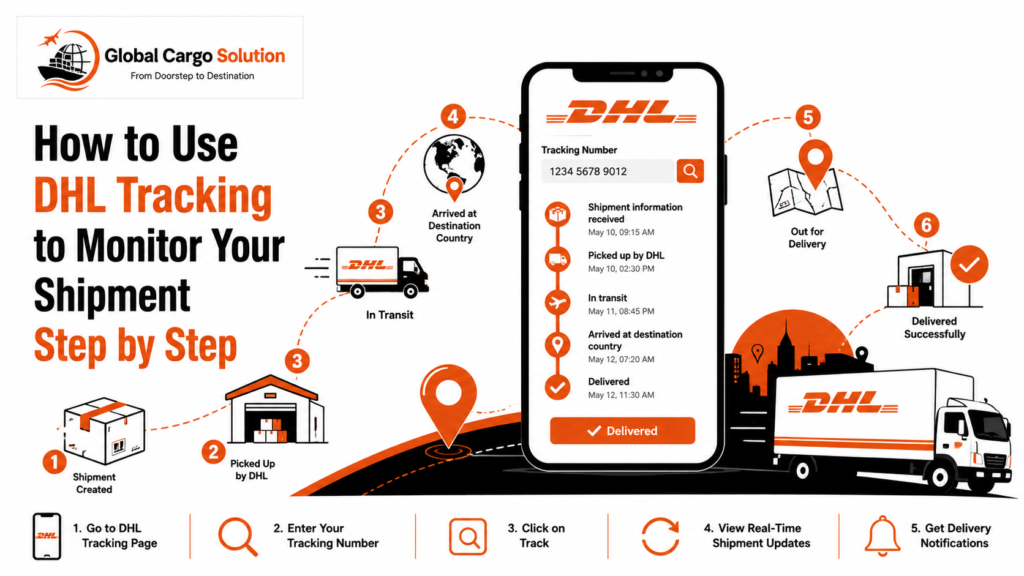
The tracking process typically follows these stages:
- Shipment collected from the sender.
- Arrival at a DHL sorting facility.
- International transportation.
- Customs clearance.
- Arrival in the destination country.
- Local distribution.
- Out for delivery.
- Successfully delivered.
Modern logistics depend heavily on shipment visibility. Businesses use tracking information to manage customer expectations, coordinate inventory, and improve supply chain efficiency. Individuals benefit from knowing exactly when important parcels or documents are expected to arrive. With DHL Shipment Tracking, customers gain complete visibility throughout the shipping process, making international logistics more transparent and dependable.
Where to Find Your DHL Tracking Number
Before you can monitor your shipment, you’ll need your tracking number. This unique reference identifies your package within DHL’s global logistics network. Fortunately, finding your tracking number is usually quick and straightforward.
Shipping Confirmation Email
If you’ve booked your shipment online, DHL typically sends a confirmation email that includes your tracking number along with shipment details. Always save this email until your package has been successfully delivered.
Shipping Receipt
Customers who visit a DHL service center receive a printed receipt after creating a shipment. The receipt contains the tracking number, shipment date, destination, and other important shipping information.
Online Retailer or Seller
If you’ve purchased products from an online store, the retailer usually sends shipping confirmation once the order has been dispatched. Most eCommerce platforms display the tracking number inside your order history or confirmation email.
Business Shipping Dashboard
Companies that frequently use DHL often manage shipments through business shipping portals. These dashboards allow employees to monitor multiple shipments simultaneously, making logistics management much more efficient. Regardless of how your shipment was created, always keep your tracking number available until the package reaches its destination.
How to Track a DHL Shipment Step by Step
Using DHL Tracking is simple and takes only a few minutes. Following these steps ensures you can monitor your package throughout its journey.
Step 1: Visit the DHL Tracking Page
Start by opening the official DHL tracking page through your web browser. The homepage includes a search field where customers can enter their shipment reference number.
Step 2: Enter Your Tracking Number
Carefully type or paste your tracking number into the search box. Double-check for typing mistakes before submitting the request. Even a single incorrect digit may prevent the system from locating your shipment.
Step 3: Verify Shipment Information
After submitting the tracking number, the system displays shipment information, including:
- Shipment origin
- Destination country
- Shipping date
- Current shipment status
- Estimated delivery progress
Review these details to ensure you’re viewing the correct shipment.
Step 4: Understand Tracking Status Updates
As your package moves through the logistics network, the tracking page updates automatically.
Common updates include:
- Shipment collected
- Processed at facility
- Departed facility
- Customs clearance
- Arrived at destination
- Out for delivery
- Delivered
These updates provide valuable insight into your shipment’s current location and expected progress. If you’re waiting for an important delivery, regularly checking these updates helps you prepare for arrival and quickly identify any unexpected delays. Businesses that frequently track DHL Shipment activities can also use this information to improve customer communication and provide accurate delivery estimates.
Step 5: Monitor Delivery Progress
Continue monitoring your shipment until its status changes to “Delivered.” Most deliveries include confirmation showing the delivery date, time, and, where applicable, recipient information. This transparency gives both senders and recipients confidence that the shipment has successfully reached its destination.
Understanding Common DHL Tracking Statuses
When monitoring your shipment, you’ll notice different tracking messages appear as the package progresses through the delivery network. Understanding these updates helps you know exactly what is happening without unnecessary concern.
| Tracking Status | Meaning | What You Should Do |
| Shipment Picked Up | DHL has collected the package. | No action required. |
| In Transit | Shipment is moving between facilities. | Continue monitoring progress. |
| Customs Clearance | Shipment is being processed by customs. | Wait unless additional documents are requested. |
| With Delivery Courier | Package is assigned to the delivery driver. | Prepare to receive the shipment. |
| Delivered | Shipment has reached its destination. | Confirm receipt if necessary. |
| Exception | Temporary issue affecting delivery. | Review details and contact support if required. |
Shipment Picked Up
This status confirms that DHL has successfully collected the package from the sender and entered it into its logistics network.
In Transit
Your shipment is moving between sorting facilities, airports, or regional distribution centers. Depending on the destination, this stage may involve multiple transportation checkpoints.
Customs Clearance
International shipments often pass through customs inspections before entering the destination country. This status usually indicates normal processing rather than a problem.
With Delivery Courier
The package has reached the final delivery station and is currently assigned to a courier for delivery. Most shipments arrive on the same day after reaching this stage.
Delivered
The shipment has been successfully delivered to the recipient. Many deliveries also include delivery confirmation for additional transparency.
Exception
An exception indicates an unexpected event such as weather delays, incorrect addresses, customs requests, or recipient unavailability. Most exceptions are temporary and resolved quickly.
Benefits of Using DHL Tracking for Businesses
Reliable shipment visibility is no longer optional for modern businesses. Customers expect accurate delivery information, while companies need better control over their supply chains. Using DHL Tracking provides several advantages that improve both operational efficiency and customer satisfaction.
Better Customer Communication
Customers frequently ask about delivery status after placing an order. With real-time tracking updates, businesses can provide accurate shipment information without relying on estimates.
This improves customer confidence while reducing uncertainty.
Improved Supply Chain Visibility
Businesses managing international imports and exports need to know exactly where shipments are located.
Real-time shipment tracking helps logistics managers coordinate inventory, warehouse operations, and production schedules more effectively.
Reduced Customer Support Requests
Many customer service inquiries relate to shipment status. When customers can monitor deliveries themselves, businesses receive fewer support requests, allowing customer service teams to focus on more complex issues.
Faster Issue Resolution
If unexpected delays occur, tracking information helps businesses identify the problem quickly. Early visibility allows companies to communicate proactively with customers and resolve shipping issues before they become larger problems.
Better Delivery Planning
Reliable shipment updates enable businesses to plan receiving schedules, warehouse staffing, and customer notifications more efficiently.
This leads to smoother logistics operations and an improved overall customer experience.
Why Individuals Should Use DHL Tracking?
Shipment tracking is equally valuable for personal deliveries. Whether you’re sending legal documents, university applications, passports, gifts, or important family parcels, knowing the exact location of your shipment provides reassurance throughout the delivery process. Individuals can monitor delivery progress, estimate arrival times, and respond quickly if any temporary delays occur. This added visibility is especially useful for international shipments where customs processing or long-distance transportation may affect delivery schedules.
By using DHL Tracking, individuals gain greater confidence that their important packages are moving safely toward their destination while staying informed every step of the journey.
Common DHL Tracking Problems and Their Solutions
Although DHL Tracking is designed to provide accurate and timely shipment updates, there may be occasions when customers encounter issues during the shipping process. Most of these situations are temporary and can be resolved quickly with the right information.
Understanding common tracking problems can help you avoid unnecessary concern and know when further action is required.
Tracking Number Not Working
One of the most common issues occurs when a tracking number cannot be found in the system.
This may happen because:
- The shipment has only recently been created.
- The tracking number was entered incorrectly.
- The package has not yet been scanned into the DHL network.
Before assuming there is a problem, verify the tracking number carefully and wait a few hours if the shipment was recently dispatched. In most cases, the system updates once the first scan has been completed.
Shipment Status Not Updating
Customers sometimes notice that shipment information remains unchanged for several hours or even a day.
This usually happens when:
- The package is traveling between logistics hubs.
- The shipment is on an international flight.
- Scanning occurs only after arrival at the next facility.
A temporary pause in updates does not necessarily indicate a delay. Once the shipment reaches the next checkpoint, the tracking information is refreshed automatically.
Customs Clearance Delays
International shipments must comply with customs regulations in the destination country.
If customs officials require additional documentation or inspections, the shipment may remain in clearance longer than expected.
To minimize customs delays:
- Ensure shipping documents are complete.
- Provide accurate product descriptions.
- Declare shipment values correctly.
- Follow import regulations for the destination country.
Businesses working with experienced logistics providers often experience fewer customs-related issues because documentation is prepared correctly before shipment.
Incorrect Delivery Status
Occasionally, recipients may believe the shipment has not arrived even though the tracking system shows “Delivered.”
Before reporting a problem:
- Check with family members or colleagues.
- Look for delivery notices.
- Contact building reception or security staff.
- Verify the delivery address.
If the package still cannot be located, contact DHL customer support immediately for assistance.
Concerns About Lost Shipments
Lost shipments are uncommon but can occur due to incorrect addresses, damaged labels, or exceptional operational circumstances.
If a shipment appears inactive for an extended period, customers should:
- Review the latest tracking update.
- Confirm shipment details.
- Contact DHL customer service.
- Request a shipment investigation if necessary.
Most shipment issues can be resolved quickly once the logistics team has reviewed the shipment history.
DHL Tracking in Saudi Arabia
Saudi Arabia has become one of the fastest-growing logistics markets in the Middle East, driven by increasing international trade, expanding eCommerce, and the country’s Vision 2030 initiatives. Businesses now depend more than ever on reliable shipment visibility to support imports, exports, and domestic distribution.
Whether shipping to Riyadh, Jeddah, Dammam, Jubail, or other commercial cities, DHL Tracking enables customers to monitor deliveries throughout every stage of the logistics process.
For businesses, accurate tracking information improves inventory management, customer communication, and supply chain planning. Online retailers can provide buyers with real-time delivery updates, reducing uncertainty and improving the overall customer experience.
Individuals also benefit from shipment visibility when sending passports, educational documents, gifts, or urgent parcels internationally.
Many companies operating in the Kingdom rely on DHL Tracking KSA because it provides dependable shipment monitoring across both domestic and international delivery networks.
As Saudi Arabia continues strengthening its role as a regional logistics hub, advanced tracking technology remains an essential part of efficient international shipping operations.
DHL Tracking vs Other Courier Tracking Services
While many logistics companies provide shipment tracking, not all tracking systems offer the same level of visibility and reliability.
The table below highlights some of the key differences.
| Feature | DHL | Other Couriers |
| Real-Time Tracking Updates | ✔ Excellent | Varies |
| International Coverage | 220+ Countries | Limited by Provider |
| Customs Status Visibility | ✔ Detailed | Basic |
| Delivery Accuracy | High | Moderate |
| Mobile & Online Tracking | Fully Supported | Usually Available |
| Business Shipping Integration | Advanced | Limited Options |
One of DHL’s biggest strengths is its integrated international logistics network. Since shipments remain within a unified transportation system for most of their journey, customers receive more consistent tracking updates than they often experience with providers relying heavily on third-party carriers.
For businesses managing global shipments, this improved visibility supports better operational planning while reducing customer inquiries about delivery status.
Best Practices for Accurate DHL Parcel Tracking
Tracking a shipment is straightforward, but following a few best practices helps ensure you always receive accurate information.
Save Your Tracking Number
Keep your shipment reference in a secure location until delivery is complete. Without the tracking number, monitoring shipment progress becomes much more difficult.
Verify Shipment Details
Always confirm that the sender’s and recipient’s information is accurate before dispatch. Incorrect names, addresses, or postal codes may create unnecessary delivery delays.
Enable Shipment Notifications
Many shipping platforms allow customers to receive email or SMS notifications whenever shipment status changes. These alerts reduce the need for repeated manual tracking.
Monitor Customs Progress
For international deliveries, customs processing is a normal part of the shipping journey. Instead of assuming a delay, monitor shipment updates carefully before contacting support.
Contact Support When Necessary
If shipment information remains unchanged for several business days or an unexpected exception appears, contacting customer service promptly can help resolve the issue faster.
Using DHL Parcel Tracking effectively gives both businesses and individuals greater visibility throughout the shipping process while improving delivery confidence.
At Global Cargo Solution, we understand that successful shipping depends on more than simply moving packages from one location to another. It requires reliable logistics, shipment visibility, and professional support at every stage of the journey. Our team helps businesses and individuals simplify international shipping through dependable freight solutions, customs expertise, and efficient logistics services.
If you’re looking for a trusted logistics partner to support your international shipping needs, Global Cargo Solution is ready to help you move your shipments safely, efficiently, and with complete confidence.
Conclusion
Reliable shipment visibility has become an essential part of international logistics. Whether you’re a business managing global supply chains or an individual sending an important parcel overseas, knowing where your shipment is at every stage provides confidence, improves planning, and reduces uncertainty. Throughout this guide, we’ve explored how DHL Tracking helps customers monitor shipments from pickup to final delivery. From understanding tracking numbers and shipment statuses to resolving common tracking issues, the system offers transparency that benefits both businesses and personal users. Real-time updates, customs visibility, and dependable delivery information make it easier to stay informed throughout the shipping journey. For businesses, accurate tracking improves customer communication, supports inventory planning, and strengthens supply chain efficiency. Individuals also benefit from greater peace of mind when sending valuable documents, gifts, or personal belongings internationally.
Frequently Asked Questions
How do I track my DHL shipment?
Visit the official DHL tracking page, enter your shipment’s tracking number, and click search. You’ll instantly see the latest shipment status, location, and delivery progress.
Why is my DHL tracking not updating?
Tracking updates may temporarily pause while your shipment is traveling between logistics facilities or undergoing customs clearance. Most updates resume automatically once the package reaches the next checkpoint.
How long does DHL tracking take to update?
In most cases, shipment information updates within a few hours after each scanning event. International shipments may experience slightly longer intervals while in transit.
Can I track international DHL shipments?
Yes. DHL provides tracking for both domestic and international shipments, allowing customers to monitor deliveries from pickup through final delivery.
What should I do if my shipment is delayed?
First, review the latest tracking information to determine the cause of the delay. If no updates appear for several business days or additional assistance is required, contact DHL customer support for further investigation.