If you’ve ever placed an online order and received it the next day, you’ve already experienced the result of effective warehousing, even if you never thought about it. But what is warehousing, exactly, and why does it play such a central role in modern supply chains? At its simplest, warehousing is the process of storing goods in a dedicated facility before they are distributed to their final destination. Yet in practice, it is far more than just putting products on a shelf and waiting for orders to come in. At Global Cargoo Solution, warehousing is one of the core services we provide to businesses across industries, and we understand firsthand how the right warehousing strategy can transform supply chain performance.
In this article, we’ll explore what is warehousing in depth, its definition, its key functions, the different types available, and how it connects to the wider world of logistics. Whether you’re a business owner evaluating your storage options or simply looking to understand how supply chains work, this guide covers everything you need to know.
What Is Warehousing? Understanding the Basics
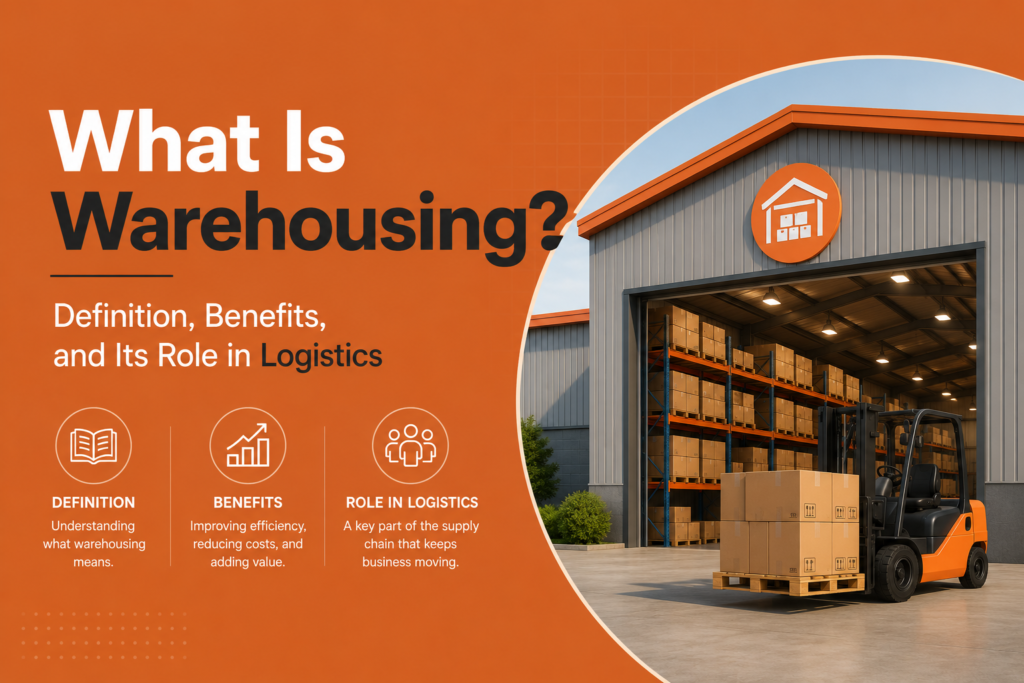
So, what is warehousing at its foundation? A warehouse is a commercial building or facility used to store raw materials, work-in-progress goods, or finished products. Warehousing refers to all the activities involved in operating that facility, receiving goods, storing them safely, managing inventory, and dispatching orders accurately and on time.
Warehousing has existed in some form for thousands of years; ancient civilisations stored grain and goods in dedicated structures to manage seasonal supply and demand. Today, however, what is warehousing has evolved into a highly sophisticated, technology-driven function that sits at the heart of global commerce.
Modern warehouses are no longer passive storage spaces. They are active logistics hubs where goods are received, sorted, consolidated, picked, packed, and shipped, often within the same day. For businesses operating at scale, a well-run warehouse is as critical to customer satisfaction as the product itself.
The Core Functions of a Warehouse
To understand what is warehousing in a practical sense, it helps to look at the key functions a warehouse performs:
Receiving, Goods arrive from suppliers or manufacturers and are checked, counted, and logged into the inventory system. Accurate receiving is the foundation of everything that follows; errors at this stage ripple through the entire operation.
Storage, Products are organised and stored in designated locations within the warehouse, whether on racking systems, in bulk floor storage, in refrigerated units, or in specialist secure areas for high-value goods. Effective storage maximises space utilisation while keeping goods accessible.
Inventory Control, Warehouses maintain a continuous record of stock levels, tracking what’s in, what’s out, and what needs replenishing. Robust inventory control prevents stockouts, reduces overstock, and ensures orders can always be fulfilled accurately.
Order Picking and Packing, When a customer order is placed, warehouse staff or automated systems locate the relevant items, pick them from their storage locations, and pack them securely for dispatch. Speed and accuracy at this stage directly affect delivery performance.
Dispatch and Distribution, Packed orders are labelled, manifested, and handed over to carriers for onward delivery. Coordination between the warehouse and the transport operation is essential to hitting delivery windows.
Returns Processing, In e-commerce, especially, warehouses handle a significant volume of returned goods, which must be assessed, restocked, or disposed of efficiently.
Warehouse Management
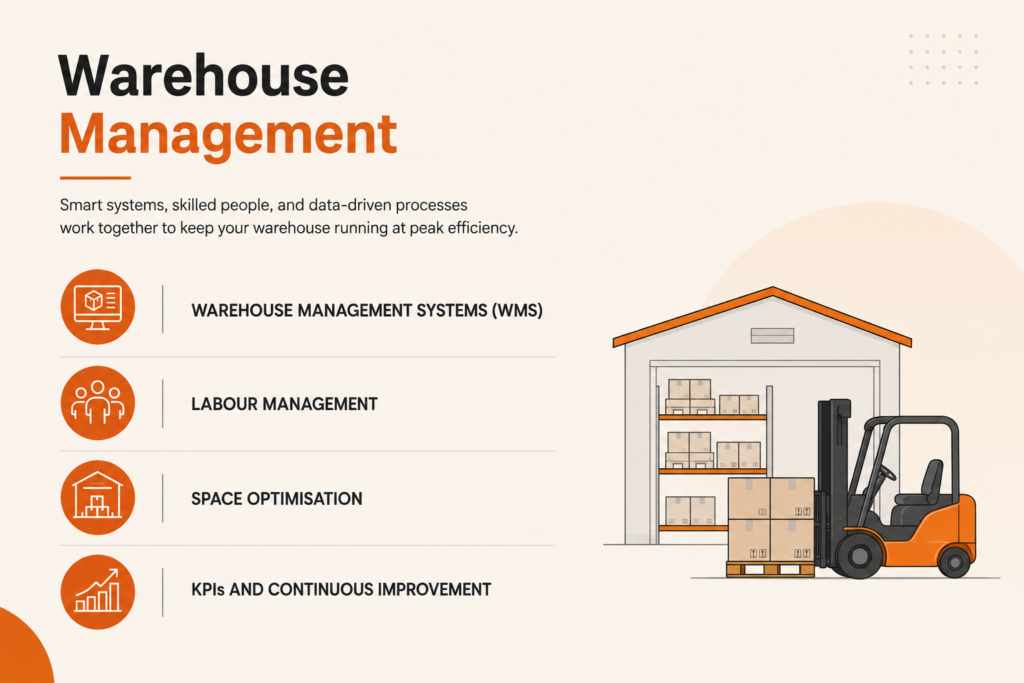
Understanding what is warehousing naturally leads to the question of how warehouses are managed effectively. Warehouse management refers to the systems, processes, and people responsible for keeping a warehouse running at peak efficiency. It’s the operational backbone that determines whether a warehouse delivers on its promise or becomes a costly bottleneck.
Warehouse Management Systems (WMS)
At the technology core of modern warehouse management is the Warehouse Management System, a software platform that controls and optimises every activity within the facility. A WMS tracks inventory in real time, directs staff to pick locations, manages inbound and outbound shipments, and generates performance reports. For high-volume operations, a WMS is not optional; it’s essential.
Leading WMS platforms integrate with broader supply chain tools, including Transportation Management Systems (TMS), Enterprise Resource Planning (ERP) software, and e-commerce platforms. This integration creates a seamless flow of data from supplier to customer, eliminating the manual errors and delays that plague disconnected systems.
Labour Management
People remain at the heart of most warehouse operations. Effective warehouse management includes workforce planning, ensuring the right number of trained staff are available to meet daily throughput targets, as well as performance monitoring, training programmes, and health and safety compliance. Labour typically represents the highest operational cost in a warehouse, so managing it well has a direct and significant impact on profitability.
Space Optimisation
How a warehouse is laid out has a major bearing on its efficiency. Warehouse management involves designing storage configurations that minimise travel distances for picking staff, maximise vertical space utilisation, and allow for smooth inbound and outbound flows without congestion. Regular slotting reviews, reassigning products to locations based on their pick frequency, can dramatically improve throughput without any capital investment.
KPIs and Continuous Improvement
Effective warehouse management is data-driven. Key performance indicators such as order accuracy rate, lines picked per hour, inventory accuracy, and cost per order are tracked regularly and used to drive continuous improvement. At Global Cargoo Solution, our warehouse management approach is built around transparency. Clients receive regular performance reports and have real-time access to their inventory data through our client portal.
Storage Solutions: Matching the Right Facility to Your Needs
A critical part of understanding what is warehousing is recognising that not all warehouses are the same. Different businesses have very different storage requirements, and choosing the right storage solutions is essential for operational efficiency and cost control.
Ambient Storage
The most common type, ambient storage, refers to standard, temperature-uncontrolled warehousing suitable for non-perishable goods such as consumer electronics, clothing, books, household goods, and industrial components. The majority of general retail and e-commerce fulfilment happens in ambient warehouses.
Temperature-Controlled Storage
For food, beverages, pharmaceuticals, and certain chemicals, temperature-controlled storage is essential. Cold chain warehouses maintain specific temperature ranges, from chilled (2–8°C) to frozen (below -18°C), to preserve product quality and comply with regulatory requirements. Managing a cold chain correctly is highly specialised and requires robust monitoring systems and rigorous standard operating procedures.
Bonded Warehouses
A bonded warehouse is an HMRC-approved facility where imported goods can be stored without payment of import duty or VAT until they are released for sale or re-exported. For businesses that import goods in bulk or manage international distribution, bonded warehousing can provide significant cash flow advantages.
Fulfilment Centres
Fulfilment centres are a specialist type of warehouse designed specifically for high-speed e-commerce order processing. Unlike traditional warehouses that may ship large pallets to retailers, fulfilment centres pick, pack, and ship individual consumer orders, often thousands per day. Speed, accuracy, and integration with online sales platforms are the defining characteristics of a good fulfilment centre.
Self-Storage and Flexible Storage
For smaller businesses or those with seasonal fluctuations in stock levels, flexible self-storage solutions provide warehousing capacity without long-term lease commitments. Pay-as-you-go models allow businesses to scale storage space up or down in line with demand, an increasingly attractive option in uncertain economic conditions.
Global Cargoo Solution offers a range of storage solutions tailored to different business needs, from ambient and temperature-controlled warehousing to dedicated fulfilment services and bonded storage for international importers.
Inventory Management
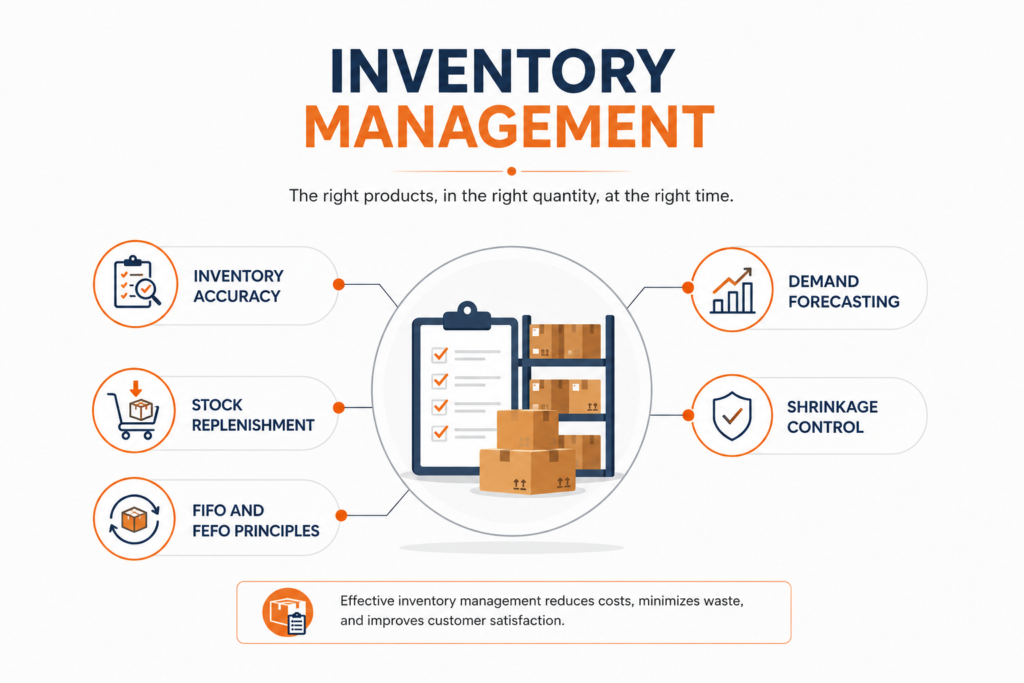
One of the most important functions embedded within what is warehousing is inventory management, the process of tracking, controlling, and optimising stock levels across your supply chain. Poor inventory management is one of the most common and costly problems businesses face, leading to stockouts that disappoint customers, overstock that ties up capital, and write-offs that erode margins.
Inventory Accuracy
The foundation of good inventory management is knowing exactly what stock you have, where it is, and in what condition. Modern warehouses achieve this through barcode scanning, RFID technology, and real-time WMS updates at every point of movement. Cycle counting, the practice of counting sections of inventory on a rolling basis rather than doing a full annual stocktake, keeps accuracy levels high without disrupting operations.
Stock Replenishment
Inventory management involves setting reorder points and minimum stock levels for each SKU, so that replenishment orders are triggered automatically before stock runs out. Getting replenishment right requires balancing the cost of holding inventory against the risk of stockouts, a calculation that varies by product, demand pattern, and supplier lead time.
FIFO and FEFO Principles
For many product categories, particularly food, beverages, and pharmaceuticals, inventory must be managed on a First In, First Out (FIFO) or First Expired, First Out (FEFO) basis to ensure older or shorter-dated stock is dispatched before newer stock. A well-configured WMS enforces these rules automatically, reducing waste and compliance risk.
Demand Forecasting
Advanced inventory management uses historical sales data, seasonal trends, and forward-looking demand signals to forecast future stock requirements. Accurate forecasting reduces both stockouts and overstock, improving cash flow and service levels simultaneously. For businesses with complex or seasonal product ranges, working with a logistics partner like Global Cargoo Solution that has forecasting expertise can make a significant difference.
Shrinkage Control
Inventory shrinkage, the loss of stock due to theft, damage, or administrative error, is a persistent challenge in warehouse operations. Robust inventory management includes security measures, damage-prevention protocols, and regular reconciliation of physical stock with system records to promptly identify and address shrinkage.
Warehouse Operations
The day-to-day reality of what is warehousing comes to life in warehouse operations, the physical activities, workflows, and processes that determine how efficiently a facility functions from shift start to shift end.
Inbound Operations
Inbound operations begin when a delivery vehicle arrives at the warehouse dock. Goods are unloaded, cross-referenced against purchase orders, inspected for damage, and scanned into the WMS. The speed and accuracy of inbound processing sets the tone for everything downstream; slow or error-prone receiving creates inventory discrepancies that are difficult and costly to resolve later.
Outbound Operations
Outbound operations cover everything from order receipt through to carrier handover. In a high-volume environment, outbound flows are tightly choreographed, pick waves are released based on carrier cut-off times, packing stations are staffed according to order volumes, and dispatch lanes are organised by carrier to avoid congestion and missed collections.
Cross-Docking
Cross-docking is a warehouse operations technique where inbound goods are transferred directly to outbound vehicles with minimal or no storage time. It is particularly effective for high-velocity products or time-sensitive shipments where the cost and delay of putting goods away and picking them back out can be eliminated.
Automation in Warehouse Operations
Automation is transforming warehouse operations at a rapid pace. Conveyor systems, automated sorting machines, goods-to-person picking robots, and autonomous mobile robots (AMRs) are now common in large-scale facilities. Automation increases throughput, reduces labour dependency, and improves accuracy, particularly for repetitive, high-volume tasks. As the technology becomes more accessible, even mid-sized operations are beginning to invest.
Health, Safety, and Compliance
Warehouse operations carry inherent physical risks, from forklift movements to manual handling injuries and working at height. A culture of safety, supported by rigorous training, clear signage, well-maintained equipment, and regular risk assessments, is non-negotiable. Compliance with health and safety legislation protects staff, reduces liability, and ensures continuity of operations.
At Global Cargoo Solution, our warehouse operations are built on a foundation of process discipline, technology integration, and a relentless focus on accuracy and speed because we know that what happens inside our warehouses directly affects our clients’ reputations with their customers. Here you can check our more freight and logistics services.
Conclusion
Understanding what is warehousing goes far beyond the image of a simple storage shed. It is a dynamic, technology-driven, and strategically critical function that underpins the entire supply chain, from the moment goods arrive from a supplier to the second they are delivered to an end customer. From warehouse management and the right storage solutions to precise inventory management and efficient warehouse operations, every element works together to ensure businesses can fulfil orders accurately, cost-effectively, and at scale. For businesses looking to optimise their supply chain, partnering with an experienced warehousing provider is one of the most impactful decisions they can make. Global Cargoo Solution offers end-to-end warehousing and logistics services designed to help businesses of all sizes store smarter, move faster, and serve their customers better. Get in touch with our team today for a tailored warehousing consultation.
Looking for reliable warehousing and logistics support? Contact Global Cargoo Solution for a free quote today.
1. What is warehousing?
Warehousing is the process of storing goods and inventory in a dedicated facility before they are distributed, sold, or transported to customers. It helps businesses manage inventory efficiently and ensure products are available when needed.
2. Why is warehousing important?
Warehousing is important because it protects inventory, improves order fulfillment, reduces delivery times, and helps businesses maintain the right stock levels. It also supports a smooth and efficient supply chain.
3. What are the different types of warehouses?
Common types of warehouses include private warehouses, public warehouses, bonded warehouses, distribution centers, smart warehouses, and fulfillment centers. Each type serves different business needs based on storage, logistics, and distribution requirements.
4. How does warehousing improve supply chain management?
Warehousing improves supply chain management by organizing inventory, reducing stock shortages, speeding up order processing, and providing better inventory tracking. This leads to faster deliveries and improved customer satisfaction.
5. What is the difference between warehousing and storage?
Storage simply refers to keeping goods in a safe place, while warehousing includes additional services such as inventory management, order picking, packing, shipping, and stock monitoring. Warehousing is a complete logistics solution rather than just a storage space.
6. Which businesses benefit from warehousing services?
Warehousing services benefit manufacturers, retailers, wholesalers, e-commerce businesses, distributors, and third-party logistics (3PL) providers. Any business that handles inventory can use warehousing to improve operations and meet customer demand more efficiently.