Every product you order online, every raw material that reaches a factory, and every shipment that crosses borders depends on one fundamental process transportation in logistics. It is the physical backbone of any supply chain, determining how quickly and cost-effectively goods move from point A to point B. Without efficient transportation in logistics, even the most sophisticated warehouse systems and inventory strategies would fail to deliver value to end customers. For businesses looking to remain competitive in today’s global marketplace, understanding how logistics and transportation work and how to optimise them is not optional. It is essential.
At Global Cargoo Solution, we help businesses across industries build smarter, faster, and more resilient logistics networks. In this guide, we break down the importance of transportation in logistics, explore the major types available, and explain how the entire process works end-to-end.
Why Transportation in Logistics Is the Backbone of Every Supply Chain?
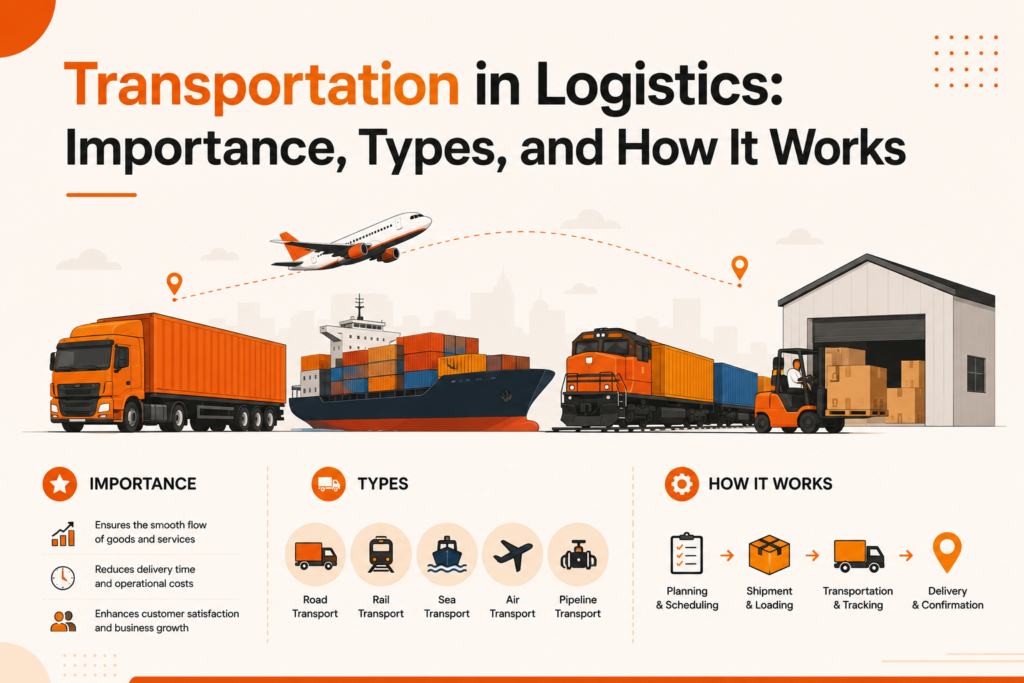
The role of transportation in logistics goes far beyond simply moving goods. It directly impacts customer satisfaction, operational costs, inventory management, and overall business competitiveness. When transportation runs efficiently, businesses can promise shorter delivery windows, reduce warehousing costs, and respond faster to market demand.
Cost Impact
Transportation typically accounts for 40–70% of total logistics costs, making it the single largest expense in most supply chains. Choosing the right mode, route, and carrier can mean the difference between healthy margins and eroding profits. Poor transportation planning leads to delays, damaged goods, missed delivery windows, and frustrated customers, all of which carry direct financial consequences.
Customer Experience
In an era where same-day and next-day delivery have become customer expectations rather than premium offerings, transportation performance is directly tied to brand reputation. Late or damaged deliveries erode trust instantly. On the other hand, reliable and transparent transportation builds loyalty and increases repeat business.
Supply Chain Resilience
Transportation networks that are well-planned and diversified across multiple modes and carriers provide businesses with flexibility during disruptions, whether caused by geopolitical events, natural disasters, or sudden demand spikes. A rigid, single-mode transportation approach creates fragility; a multi-modal, well-managed approach creates strength.
Inventory Optimisation
Efficient transportation in logistics enables businesses to adopt lean inventory models, carrying less stock while maintaining service levels. When you can confidently predict delivery timelines, you need fewer safety buffers, which frees up working capital.
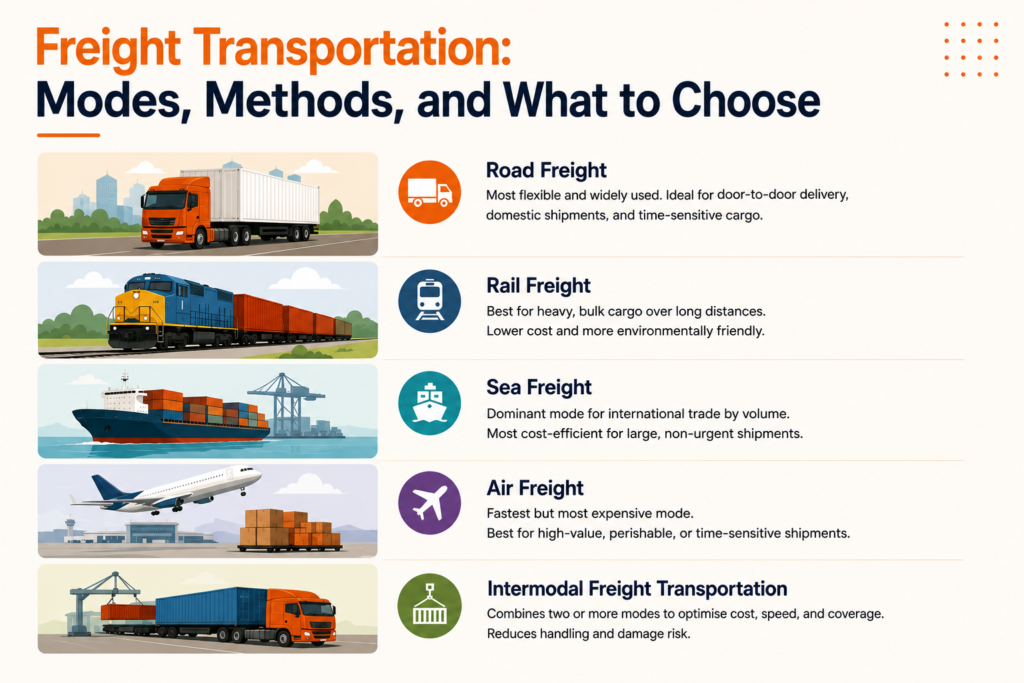
Freight Transportation: Modes, Methods, and What to Choose
Freight transportation is the operational engine of logistics, the actual movement of goods using different physical carriers and infrastructure. Selecting the right freight transportation mode depends on several factors: the nature of the cargo, distance, delivery urgency, cost constraints, and regulatory requirements.
Road Freight
Road freight is the most flexible and widely used mode of freight transportation globally. It provides door-to-door delivery, works across diverse geographies, and requires no additional transfer points. Road transport is ideal for domestic shipments, last-mile delivery, and time-sensitive cargo in urban or regional areas.
Road freight includes full truckload (FTL) for large, single-customer shipments, and less-than-truckload (LTL) for smaller consignments consolidated with other shippers’ goods, making it cost-effective for businesses of all sizes.
Rail Freight
Rail is best suited for heavy, bulk cargo over long distances, such as coal, grain, steel, chemicals, or automotive parts. Rail freight transportation offers lower costs per tonne-kilometre compared to road transport for large volumes, and it generates significantly less carbon emissions. While less flexible in terms of origin and destination access, intermodal rail-road combinations address this limitation effectively.
Sea Freight
For international trade, sea freight is the dominant mode of freight transportation by volume. Ocean shipping handles over 80% of global trade cargo. It is unmatched in capacity, a single container ship can carry over 20,000 TEUs (twenty-foot equivalent units), and is the most cost-efficient option for large international shipments that are not time-critical.
Sea freight includes FCL (full container load) for dedicated shipments and LCL (less-than-container load) for smaller international consignments.
Air Freight
Air freight transportation is the fastest but most expensive mode available. It is reserved for high-value goods, perishable items, pharmaceuticals, or time-sensitive shipments where speed justifies the premium cost. Air freight also provides the highest level of security and tracking visibility, which is important for sensitive cargo.
Intermodal Freight Transportation
Intermodal freight combines two or more transportation modes, for example, rail + road, or sea + road, to optimise cost, speed, and coverage. Cargo moves in a standardised container without repacking at transfer points, reducing handling costs and damage risk. Intermodal is rapidly growing as businesses seek flexible, efficient freight transportation solutions.
Transport Management
Transport management is the strategic and operational process of planning, executing, and optimising the movement of goods. It involves a wide range of decisions and activities from carrier selection and route planning to documentation, tracking, and performance analysis.
Transport Management Systems (TMS)
A Transport Management System is the technological foundation of modern logistics. It gives logistics teams real-time visibility into shipments, automates carrier selection based on cost and transit time, generates shipping documentation, and provides analytics for continuous improvement.
At Global Cargoo Solution, our transport management processes are supported by advanced digital tools that ensure clients always know where their cargo is, what it costs, and when it will arrive with no surprises.
Carrier Selection and Relationship Management
Effective transport management starts with building a reliable network of carriers across all required modes and lanes. This means vetting carriers for service quality, reliability, compliance, and cost competitiveness. Long-term carrier relationships often yield better rates, priority capacity, and faster problem resolution.
Route Optimisation
Route planning is one of the most impactful levers in transport management. Optimised routes reduce transit time, fuel consumption, and carbon emissions. Modern logistics providers use data-driven algorithms to factor in traffic patterns, border crossing times, carrier schedules, and seasonal variations to build efficient routes.
Compliance and Documentation
Cross-border freight transportation requires meticulous documentation, including bills of lading, customs declarations, certificates of origin, insurance papers, and more. Errors or omissions can cause costly delays at customs. Strong transport management processes include robust documentation workflows to ensure every shipment is fully compliant.
Performance Monitoring
Transport management does not end at delivery. Analysing key performance indicators on-time delivery rate, cost per shipment, transit time variance, and damage rates allows logistics teams to identify underperforming lanes or carriers and make evidence-based improvements over time.
The Step-by-Step Journey of a Shipment in Cargo Movement
Cargo movement describes the physical journey that goods take from their point of origin to their final destination. While the steps may vary depending on the mode and geography, the fundamental process follows a consistent structure.
Step 1: Order and Booking
The cargo movement process begins when a shipper places an order for transportation services. A logistics provider like Global Cargoo Solution reviews the shipment details, weight, volume, commodity type, origin, destination, required delivery date, and recommends the optimal mode and carrier.
Step 2: Pickup and First-Mile Transportation
Once the booking is confirmed, the cargo is collected from the shipper’s location. For international shipments, this typically involves road transport from the manufacturer or warehouse to a port, rail terminal, or airport. This first-mile segment is critical; delays here cascade through the rest of the journey.
Step 3: Consolidation and Loading
At the origin terminal or hub, cargo may be consolidated with other shipments (for LCL or LTL consignments). It is then loaded onto the primary carrier vessel, aircraft, train, or truck for the main haul.
Step 4: Main Haul Transportation
This is the primary cargo movement leg of the long-distance journey by sea, air, road, or rail. During this phase, modern TMS platforms provide real-time tracking updates, and any exceptions (delays, route changes, mechanical issues) are flagged immediately for proactive management.
Step 5: Deconsolidation and Customs Clearance
On arrival at the destination country or region, cargo is offloaded and, for international shipments, processed through customs. This stage requires accurate documentation and may involve physical inspection of goods. Experienced logistics providers have established relationships with customs authorities and local agents to expedite clearance.
Step 6: Last-Mile Delivery
The final leg of cargo movement involves transporting goods from the destination terminal or distribution centre to the end customer’s premises. Last-mile delivery is often the most complex and expensive segment, particularly for urban deliveries due to traffic congestion, delivery access restrictions, and the need for precise timing.
Step 7: Proof of Delivery and Documentation Close-Out
Cargo movement is formally completed when a proof of delivery (POD) is obtained, and all associated documentation is filed and archived. This confirms that the shipment reached its intended recipient in the agreed condition and timeframe.
How Global Cargoo Solution Manages Transportation in Logistics
At Global Cargoo Solution, we understand that every client’s supply chain is unique. That is why we offer tailored transportation in logistics solutions designed around your cargo type, trade lanes, delivery requirements, and budget.
Our capabilities include:
- Multi-modal freight transportation across road, sea, air, and rail
- End-to-end transport management from origin pickup to final delivery
- Real-time tracking and visibility for full transparency at every stage
- Customs brokerage and compliance support for seamless cross-border cargo movement
- Dedicated account management ensuring proactive communication and fast problem resolution
- Data-driven performance reporting to continuously optimise your logistics operations
Whether you are a small business shipping your first international consignment or a large enterprise managing complex global supply chains, Global Cargoo Solution has the network, technology, and expertise to deliver results.
Conclusion
Transportation in logistics is far more than a back-office operational function; it is a strategic capability that directly determines whether a business can compete, scale, and satisfy its customers in a demanding global market. From choosing the right freight transportation mode to implementing robust transport management processes and executing precise cargo movement operations, every decision in the logistics chain connects back to transportation. Businesses that invest in understanding and optimising their transportation in logistics operations consistently outperform those that treat it as an afterthought. The right logistics partner makes all the difference. Global Cargoo Solution is here to help you move smarter, deliver faster, and grow stronger one shipment at a time.
Frequently Asked Question
1. How to reduce transportation cost in logistics?
Reducing transportation costs in logistics involves optimizing delivery routes, consolidating shipments, improving load planning, selecting cost-effective carriers, using transportation management systems (TMS), reducing empty miles, and leveraging real-time shipment tracking. Regularly reviewing freight expenses and negotiating carrier rates can also help lower overall transportation costs.
2. How to reduce transportation cost in logistics (alternative methods)?
Alternative ways to reduce transportation costs include using multimodal transportation, partnering with third-party logistics (3PL) providers, improving warehouse locations, increasing vehicle utilization, adopting fuel-efficient vehicles, automating logistics processes, and forecasting demand more accurately to minimize urgent or last-minute shipments.
3. What is transportation in logistics?
Transportation in logistics is the process of moving goods, raw materials, or products from one location to another within the supply chain. It includes planning, managing, and executing shipments through road, rail, air, sea, or intermodal transport to ensure products reach their destination safely, efficiently, and on time.
4. What is transportation in logistics and why is it important?
Transportation in logistics is the movement of goods between suppliers, manufacturers, warehouses, distributors, and customers. It is important because it enables businesses to meet customer demand, reduce delivery times, maintain inventory flow, and support efficient supply chain operations. Effective transportation also helps lower costs and improve customer satisfaction.
5. How does transportation in logistics improve supply chain efficiency?
Transportation improves supply chain efficiency by ensuring products are delivered quickly and reliably while minimizing delays and transportation costs. Optimized routing, real-time tracking, and efficient carrier management help businesses maintain inventory levels, improve order fulfillment, and respond more effectively to customer demand.
6. What are the different types of transportation in logistics?
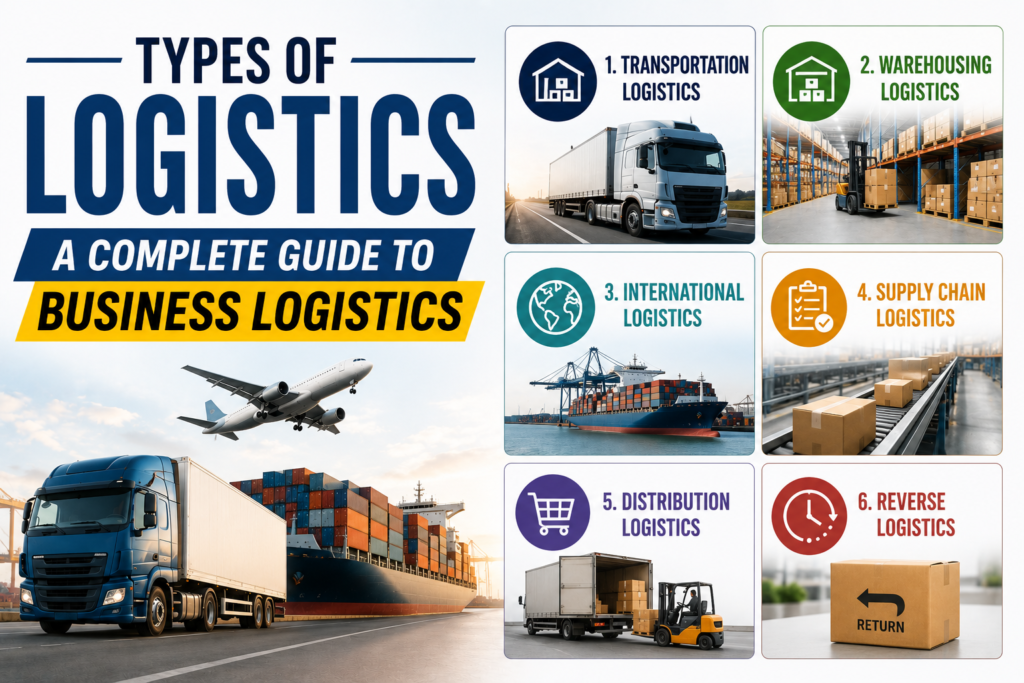
The main types of transportation in logistics are:
- Road transportation: Best for flexible local and regional deliveries.
- Rail transportation: Ideal for moving heavy goods over long distances at a lower cost.
- Air transportation: Fastest option for urgent or high-value shipments.
- Sea transportation: Most economical for international and bulk cargo.
- Intermodal transportation: Combines multiple transportation modes to improve efficiency and reduce costs while maintaining reliable deliveries.