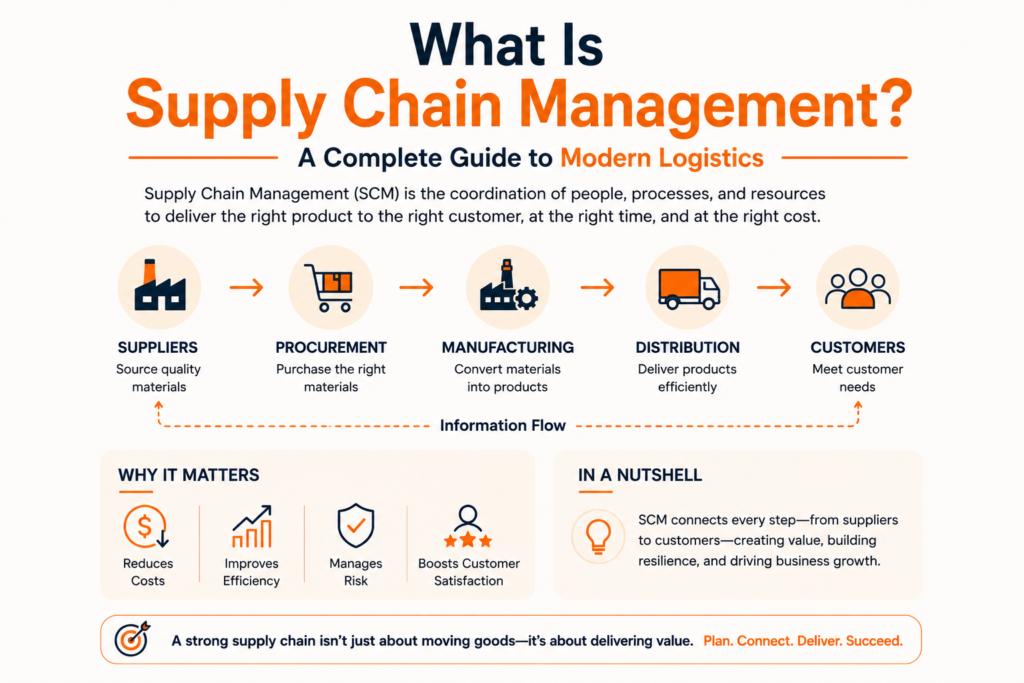
In today’s connected business environment, products move across cities, countries, and continents before reaching customers. Behind this movement is a structured process that ensures goods are sourced, produced, stored, transported, and delivered efficiently. Many businesses rely on this process to reduce costs, improve customer satisfaction, and maintain consistent operations. This raises an important question: what is supply chain management? Supply chain management is the process of planning, coordinating, and managing the flow of goods, services, information, and resources from suppliers to end customers. It involves multiple activities that work together to ensure products arrive at the right place, at the right time, and at the right cost. Modern businesses depend heavily on supply chain strategies because operational efficiency directly affects competitiveness and profitability. Whether managing transportation, warehousing, relocation services, cargo operations, or inventory movement, effective supply chain practices create smoother business processes and stronger customer experiences.
This guide explains what supply chain management is, how it works, and why it has become one of the most important functions in modern logistics.
Supply Chain
To understand what is supply chain management, it is necessary to first understand the concept of a supply chain.
A supply chain refers to the complete network of individuals, organizations, activities, and technologies involved in producing and delivering a product or service. It begins with raw material sourcing and continues through manufacturing, storage, transportation, distribution, and final delivery.
Every business operates within a supply chain regardless of industry. Retail companies move products to consumers, manufacturers source materials globally, and logistics providers coordinate transportation and warehousing activities.
The typical stages of a supply chain include:
1. Procurement
This stage focuses on acquiring raw materials, goods, or services required for production.
2. Production
Manufacturing or preparing products according to customer demand.
3. Storage
Finished products are stored before shipment.
4. Transportation
Products move between suppliers, warehouses, and customers.
5. Delivery
Final products reach customers through coordinated logistics operations.
Supply chains can be simple or highly complex. Small businesses may work with a few suppliers, while global organizations manage thousands of suppliers and transportation routes across multiple countries.
Understanding these stages helps explain what is supply chain management because the process involves controlling and optimizing every stage.
Key Objectives of Supply Chain Operations
- Reduce operational costs
- Improve service levels
- Increase delivery speed
- Minimize delays
- Strengthen supplier relationships
- Improve customer satisfaction
Businesses that invest in efficient supply chains often achieve stronger long-term performance.
Logistics Management
One of the most important components of understanding what is supply chain management is recognizing the role of logistics management.
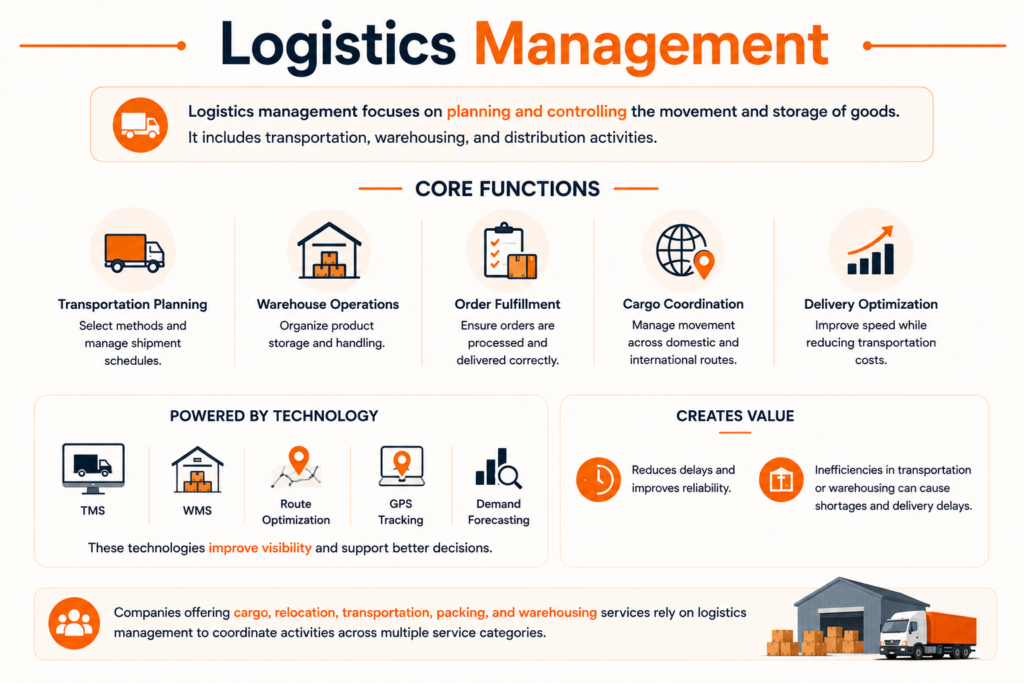
Logistics management focuses specifically on planning and controlling the movement and storage of goods. While supply chain management oversees the entire process from sourcing to delivery, logistics management concentrates on transportation, warehousing, and distribution activities.
Core functions of logistics management include:
Transportation Planning
Selecting transportation methods and managing shipment schedules.
Warehouse Operations
Organizing product storage and handling.
Order Fulfillment
Ensuring customer orders are processed and delivered correctly.
Cargo Coordination
Managing movement across domestic and international routes.
Delivery Optimization
Improving speed while reducing transportation costs.
Effective logistics management creates value by reducing delays and improving reliability.
For example, if transportation schedules fail, inventory shortages may occur. If warehousing processes become inefficient, customer deliveries may be delayed.
Modern logistics management increasingly depends on technology, including:
- Transportation Management Systems (TMS)
- Warehouse Management Systems (WMS)
- Route optimization software
- GPS tracking systems
- Demand forecasting tools
These technologies improve visibility and help organizations make informed operational decisions.
Companies providing cargo, relocation, transportation, packing, and warehousing services often rely heavily on logistics management principles to coordinate activities across multiple service categories.
Benefits of Effective Logistics Management
- Faster order fulfillment
- Better resource allocation
- Improved customer satisfaction
- Reduced operational costs
- Increased supply chain visibility
Because logistics directly influences customer experience, it remains a major focus within supply chain operations.
Inventory Control
Inventory control is another critical component when discussing what is supply chain management.
Inventory control refers to managing stock levels to ensure products are available when needed without creating unnecessary storage costs.
Poor inventory management can lead to:
- Excess storage expenses
- Product shortages
- Delayed customer deliveries
- Lost revenue opportunities
Inventory control aims to balance supply and demand effectively.
Major Inventory Control Methods
Just-In-Time Inventory
Products arrive only when required.
Safety Stock
Additional inventory is maintained to reduce disruption risk.
ABC Analysis
Inventory is categorized according to business value.
Reorder Point Method
Automatic replenishment occurs when inventory reaches a specific threshold.
Economic Order Quantity
Businesses determine ideal purchase quantities.
Effective inventory control supports supply chain performance by improving product availability and reducing waste.
Technology has significantly improved inventory management through:
- Barcode systems
- RFID tracking
- Automated stock updates
- Inventory forecasting
- Real-time reporting
Inventory decisions directly affect transportation schedules, warehouse capacity, and customer service.
For logistics companies and transportation providers, inventory control improves operational planning and prevents service interruptions.
Businesses that maintain healthy inventory practices often experience:
- Lower carrying costs
- Better warehouse utilization
- Improved customer retention
- More accurate forecasting
Inventory control is no longer limited to large enterprises. Businesses of all sizes can benefit from structured inventory strategies.
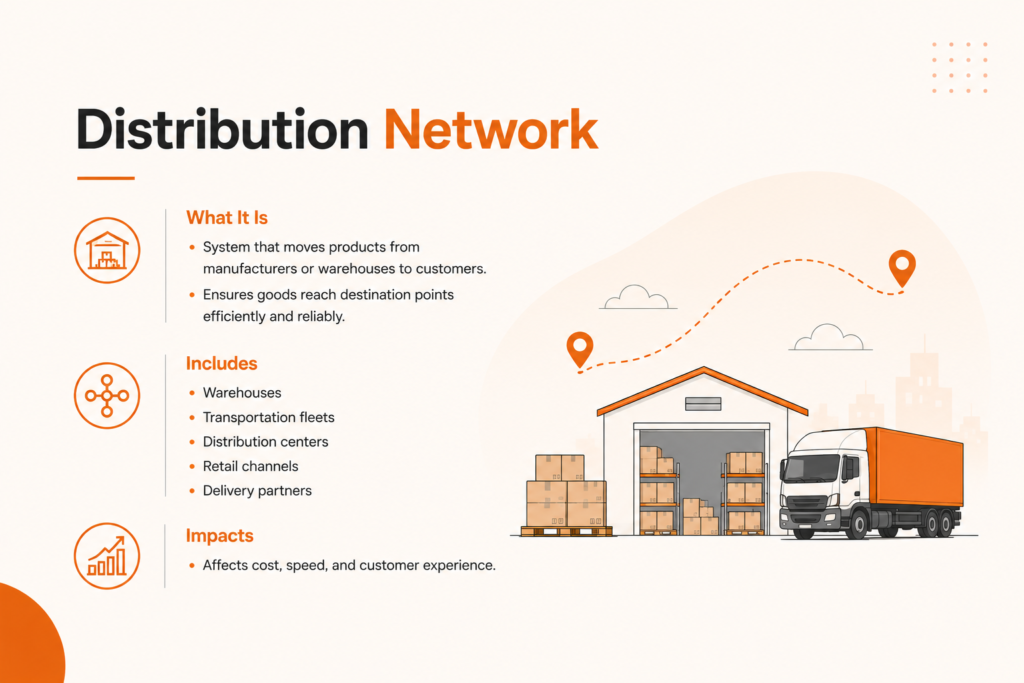
Distribution Network
A distribution network is another essential area to understand when exploring what is supply chain management.
A distribution network refers to the system that moves products from manufacturers or warehouses to customers.
Its primary purpose is ensuring goods reach destination points efficiently and reliably.
Distribution networks may include:
- Warehouses
- Transportation fleets
- Distribution centers
- Retail channels
- Delivery partners
The structure of a distribution network affects cost, speed, and customer experience.
Types of Distribution Networks
Centralized Distribution
Products are stored in one major facility.
Decentralized Distribution
Products are spread across multiple regional facilities.
Direct Distribution
Manufacturers deliver directly to customers.
Hybrid Distribution
A combination of centralized and regional approaches.
An optimized distribution network creates competitive advantages by reducing delivery times and improving order accuracy.
Key performance indicators include:
- Delivery speed
- Transportation cost
- Order accuracy
- Warehouse utilization
- Customer satisfaction
Technology plays a major role in improving distribution networks.
Examples include:
- Delivery tracking systems
- Route optimization software
- Automated scheduling
- Demand forecasting platforms
Companies involved in cargo movement, relocation, transportation services, and warehousing often depend on strong distribution networks to maintain consistent service quality.
Why Supply Chain Management Matters in Modern Business
Businesses operate in highly competitive markets where speed, reliability, and cost efficiency directly influence success.
Organizations that prioritize supply chain performance gain advantages through:
- Reduced operational expenses
- Faster response times
- Better inventory management
- Improved delivery performance
- Stronger customer relationships
Supply chain disruptions can create significant financial consequences.
Common challenges include:
- Transportation delays
- Inventory shortages
- Rising fuel costs
- Global supply interruptions
- Warehouse constraints
Businesses that build resilient supply chain systems recover more effectively from disruptions.
Supply chain management also contributes to sustainability by reducing waste, improving transportation efficiency, and supporting better resource utilization.
Future Trends in Supply Chain Management
The future of supply chain operations continues to evolve.
Major trends include:
- Artificial intelligence
- Predictive analytics
- Warehouse automation
- Real-time tracking
- Sustainable logistics
- Smart transportation systems
These innovations improve decision-making and increase operational visibility.
Organizations that adopt modern supply chain practices position themselves for long-term growth.
Conclusion
Understanding what is supply chain management is essential for businesses seeking efficiency, reliability, and sustainable growth. Supply chain management coordinates every stage of product movement—from sourcing and inventory handling to transportation and final delivery. By strengthening supply chain operations through effective logistics management, accurate inventory control, and optimized distribution networks, businesses can improve customer satisfaction and achieve stronger operational performance. As markets continue to evolve, organizations that invest in modern supply chain practices will remain better prepared for future opportunities and challenges.
Frequently Asked Questions
1. What is supply chain management?
Supply chain management (SCM) is the process of planning, coordinating, and managing the flow of goods, services, information, and finances from raw material suppliers to the end customer. It involves sourcing, manufacturing, warehousing, transportation, and distribution to ensure products are delivered efficiently and cost-effectively.
2. What is the role of supply chain management?
The role of supply chain management is to ensure products move smoothly through every stage of the supply chain. It helps businesses reduce costs, improve operational efficiency, maintain inventory levels, manage supplier relationships, minimize delays, and deliver products to customers on time.
3. What is logistics and supply chain management?
Logistics and supply chain management refers to the combined process of managing the movement, storage, and coordination of goods throughout the entire supply chain. While logistics focuses on transportation, warehousing, and delivery, supply chain management oversees the broader strategy, including procurement, production, inventory, and supplier management.
4. What is procurement and supply chain management?
Procurement and supply chain management involves sourcing raw materials, products, and services from suppliers while managing the entire supply chain from purchasing to final delivery. Procurement focuses on acquiring the right goods at the best value, while supply chain management ensures those goods are efficiently produced, stored, transported, and delivered.
5. What is the difference between logistics and supply chain management?
The main difference is that logistics focuses on the transportation, storage, and distribution of goods, whereas supply chain management covers the entire process from sourcing raw materials to delivering finished products to customers. Logistics is one part of supply chain management, while SCM includes procurement, production, inventory management, logistics, and supplier coordination.
6. What is the meaning of supply chain management?
The meaning of supply chain management is the strategic coordination of all activities involved in producing and delivering a product or service. It ensures every stage, from purchasing raw materials and manufacturing to warehousing, shipping, and customer delivery, works together efficiently to maximize value and customer satisfaction.