Sending a parcel across the world used to mean stacks of paperwork, unclear timelines, and a fair amount of guesswork. DHL has simplified most of that, but the process still involves real steps, steps that are worth understanding whether you’re a business shipping products to customers overseas or an individual sending a one-off package to family abroad. As cross-border e-commerce and international trade keep growing, more people are booking shipments who’ve never had to think about customs forms or clearance timelines before.
This guide breaks down how DHL international shipping actually works, from booking to final delivery, along with what affects cost and speed, who each service tier is really built for, and how a partner like Global Cargo Solution (GCS) fits into the process for businesses and individuals shipping out of Riyadh.
What Is DHL International Shipping?
At its core, DHL international shipping means moving parcels, documents, or freight from one country to another using DHL’s global network. Unlike domestic shipping, it involves crossing borders, which brings customs declarations, import duties, and destination-country regulations into play. These extra layers are exactly why International shipping services exist as a distinct category from standard courier work; they require more coordination, more documentation, and a network capable of handling clearance in dozens of countries at once.
For anyone new to it, the idea can sound complicated. In practice, DHL has streamlined most of the heavy lifting, but understanding the basic steps still helps avoid delays and unnecessary costs. Even experienced shippers occasionally run into holdups simply because a form was filled out incorrectly or a service tier didn’t match the shipment’s actual urgency, small mistakes that are easy to avoid once you know what to look out for.
How the DHL International Shipping Process Works
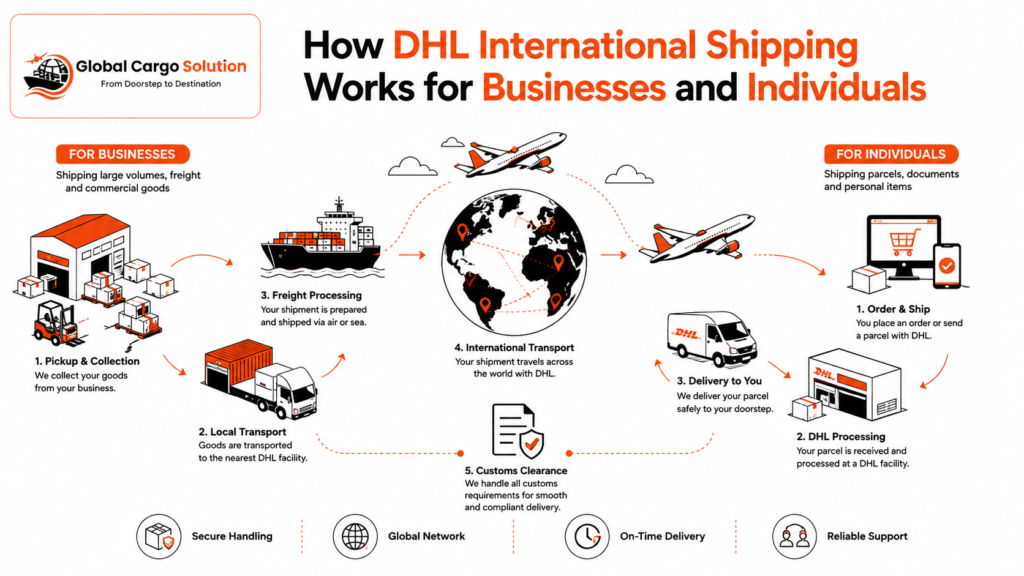
Here’s what actually happens between the moment you book a shipment and the moment it lands in someone else’s hands on the other side of the world.
Step 1: Booking and Packaging
Everything starts with booking either online, through an account manager, or at a branch. At this stage, you’ll need accurate weight and dimensions, since these directly affect cost. Packaging matters more for international shipments than domestic ones, since parcels pass through more handling points and longer transit times before reaching their destination.
Step 2: Customs Documentation
This is the step most first-time shippers underestimate. International shipments need a commercial invoice (for goods) or a customs declaration form, listing contents, value, and purpose of shipment. Missing or inaccurate documentation is the single most common reason international parcels get held up, and it’s usually the easiest problem to prevent. It just takes a few extra minutes of care before drop-off.
Step 3: Pickup and Transit
Once booked and documented, the shipment is picked up and routed through DHL’s network, typically moving through a regional hub before heading toward the destination country. Express shipments usually move by air, while economy and freight options may combine air and ground transport to reduce cost. During this stage, tracking numbers update at each major checkpoint, giving both sender and recipient visibility into where the shipment actually is rather than just an estimated delivery date.
Step 4: Customs Clearance at Destination
Before delivery, the shipment clears customs in the destination country. This is where import duties and taxes, if applicable, get calculated and applied. Clearance times vary significantly by country, some process shipments within hours, others can take a few days depending on volume and regulations.
Step 5: Final Delivery
Once cleared, the shipment moves to local delivery. For businesses, this often means direct delivery to a warehouse or office; for individuals, it’s typically a home or personal address. Tracking updates throughout this stage let both sender and recipient know exactly where things stand.
DHL Shipping Options for International Deliveries
Not every shipment needs the same service tier, and DHL structures its offerings around that reality. Express is the fastest option, built for time-sensitive documents and parcels that need to arrive within a few days. It’s the default choice for urgent business shipments or anything with a tight deadline.
Economy or standard DHL shipping trades speed for cost is a sensible option when the shipment isn’t urgent and a slightly longer transit window is acceptable. This tier is popular with individuals and smaller businesses managing shipping budgets carefully.
Freight services handle bulk cargo pallets, large commercial shipments, and high-volume orders that don’t fit the parcel model at all. Businesses importing inventory or exporting products at scale typically rely on this tier rather than express or economy options.
Across all three, DHL worldwide shipping infrastructure is what makes consistent tracking and delivery standards possible, regardless of which tier is chosen or which country the shipment is heading to.
What Affects Cost and Delivery Time
Two shipments of similar size can end up costing very different amounts, and the reasons usually come down to a handful of predictable factors rather than anything random. A few of these consistently drive both price and speed for international shipments:
- Weight and dimensions: Heavier and bulkier shipments cost more and may shift which service tier makes sense.
- Destination country: Some countries have faster, more predictable customs processes than others.
- Customs duties and taxes: These vary by country and product category, and they’re separate from the shipping cost itself.
- Service tier chosen: Express costs more than economy but significantly cuts transit time.
- Peak seasons: Periods like major holidays or global sale events can extend delivery windows due to higher shipment volume.
None of these are things you can fully predict in advance, but understanding them helps set realistic expectations before a shipment goes out.
DHL International Shipping for Businesses vs. Individuals
For Businesses
Companies shipping internationally on a regular basis usually benefit from bulk shipping accounts, which often come with better rates, simplified invoicing, and integration options for e-commerce platforms. Recurring shipments also make it worth setting up standardized documentation templates, since the same product categories tend to ship repeatedly.
For Individuals
For a one-off shipment of a gift, personal documents, or a package to family overseas, the process is simpler. There’s no need for bulk accounts or integrations, just accurate documentation and the right service tier for the urgency of the shipment. International courier services at this scale are usually booked directly through a branch or online portal without much additional setup.
Common Challenges with International Courier Services (and How to Avoid Them)
A few issues come up repeatedly with international shipments, and most are avoidable:
- Missing or incorrect customs paperwork: Double-check invoice details and declared values before drop-off; this alone prevents most clearance delays.
- Prohibited or restricted items: Regulations vary by destination country, so it’s worth confirming before shipping anything unusual, especially electronics, batteries, or food items.
- Underestimating transit time: Economy shipments take longer than express, and that gap widens further during peak seasons; build in a buffer rather than assuming best-case timelines.
- Incomplete recipient information: An unclear or incomplete delivery address is a common, easily avoidable cause of delays at the final delivery stage.
How GCS Supports DHL International Shipping in Riyadh
For businesses in Riyadh shipping internationally regularly, managing every detail of the process alone can get time-consuming. GCS works as a collaborative partner alongside DHL, helping businesses handle documentation, coordinate bookings, and track shipments without needing to manage every step independently.
This kind of support is particularly useful for companies juggling multiple international shipments at once, where even small documentation errors can cause delays across several orders. Rather than replacing DHL’s service, GCS adds a local layer of coordination- someone familiar with both the shipment’s specifics and DHL’s processes, available to step in when questions or issues come up.
For individuals or smaller businesses shipping less frequently, this kind of support can still be valuable when a shipment is unusually complex or time-sensitive, and a bit of extra guidance helps avoid costly mistakes.
Conclusion
DHL international shipping doesn’t have to feel complicated once you understand the steps involved in booking, documentation, transit, clearance, and delivery. Whether you’re a business managing recurring shipments or an individual sending a single package abroad, choosing the right service tier and preparing accurate paperwork makes the biggest difference in cost and speed. If you’d like to support managing the process, GCS works alongside DHL as a collaborative partner to help keep your shipments on track.
Get in touch with our team to see how we can help with your next international shipment.
Frequently Asked Questions
How long does DHL international shipping take?
It depends on the service tier, destination, express shipments often arrive within a few days, while economy options can take a week or more, especially during peak seasons.
What documents are needed for international shipments?
At minimum, a commercial invoice or customs declaration listing contents, value, and purpose of shipment. Additional documents may be required depending on the product type and destination country.
Is DHL Express faster than standard shipping options?
Yes, express is built specifically for speed, while standard and economy tiers prioritize cost over transit time.
Can GCS help me book an international shipment through DHL?
Yes. GCS supports businesses and individuals in Riyadh with documentation, coordination, and tracking for shipments moving through DHL’s international network.
Can I track my DHL shipment in real time?
Yes. DHL provides real-time tracking for most shipments, allowing you to monitor your parcel’s status, estimated delivery time, and transit updates from dispatch to final delivery.